RESEARCH · 12 min
Is GPTZero Close to Turnitin? 2026 Research
GPTZero matches Turnitin on human writing but not on edited or rewritten AI text. Here is the 2026 evidence and the free checks worth running instead.
Read →Blog › GUIDES
A 20% or 25% Turnitin score means different things for the AI score and the similarity score. Here is how to read each one, and how to check your draft first.
For Turnitin's AI score, 20% is the cut-off: below it Turnitin shows only an asterisk, and above it Turnitin says false positives are under 1%. A 20% or 25% similarity score is a different number: it sits in Turnitin's green (1% to 24%) or yellow (25% to 49%) band, and your instructor decides what is acceptable (Turnitin Guides). Check your draft in Walter's free AI detector before you submit.
A Turnitin score starts a conversation; Turnitin itself says it does not decide misconduct.
| AI writing score | Similarity score | |
|---|---|---|
| What it measures | How much of the text Turnitin estimates was written by AI | How much of the text matches other sources |
| Under 20% | Shown as *% with no highlights (less reliable range) | Green band (1% to 24%) |
| 20% to 25% | A number is shown; Turnitin's document false positive rate is under 1% above 20% | Green to yellow (yellow starts at 25%) |
| Who decides what is acceptable | Your instructor and school policy | Your instructor and school policy |
Sources: Turnitin Help Center, Turnitin's Chief Product Officer (2023) and Turnitin Guides.
Turnitin's own testing found that results below 20% AI writing had a higher incidence of false positives, which is why it shows only an asterisk there (Turnitin, 2023). Above 20%, Turnitin says its document false positive rate is under 1%, which it explains as possibly flagging one in every 100 human-written documents. It also says its sentence-level false positive rate is about 4%, and that an AI writing check needs at least 300 words.
So a 20% to 25% AI score is a real signal that part of the text reads as AI, but Turnitin itself tells educators to use the score to start a conversation, not to decide misconduct (Turnitin, 2023).
The percentage is the share of qualifying text, meaning prose sentences in paragraphs, that Turnitin's model judges likely AI-generated, including AI text later changed by a paraphraser or bypasser (Turnitin Guides). Two consequences follow. First, a 25% on a 2,000 word essay means roughly 500 words of prose read as AI to the model, usually in a few clusters, not sprinkled evenly. Second, bullet lists, tables and reference lists are left out of the calculation, so a document that is mostly lists can show a percentage based on a small amount of prose. Turnitin only scores qualifying prose, meaning sentences in paragraphs; it does not reliably score bullet points, tables, poetry, code or annotated bibliographies, it needs at least 300 words, and it accepts up to 30,000 words (Turnitin Guides, release notes).
Turnitin's own testing found a higher rate of false positives when the percentage was between 0 and 19, so since July 2024 it shows an asterisk there and highlights nothing (Turnitin Guides). In practice that makes 20% the most important number on the AI side of the report: under it, your instructor sees no figure and no highlights; at or above it, they see both. A paper that moves from 18% to 22% looks very different on screen even though the underlying change is small.
The similarity score is not an AI score and not a plagiarism verdict. Turnitin says it compares your work with its database and highlights matches, and that correctly used quotes and references still count as matches (Turnitin Guides). Its color bands run green from one word to 24%, yellow from 25% to 49%, orange from 50% to 74% and red from 75% to 100%. Turnitin also says every school, instructor or assignment can set a different acceptable range, so your syllabus is the real answer.
| Score | If it is the AI score | If it is the similarity score |
|---|---|---|
| 0% | No qualifying text detected as AI | No matches found (rare on cited work) |
| 10% to 15% | Hidden: shown as *% with no highlights | Green band; usually citations and common phrases |
| 20% | The first number Turnitin will show, with highlights | Green band |
| 25% | About a quarter of the prose reads as AI to Turnitin; expect questions | Start of the yellow band (25% to 49%) |
| 30% to 40% | A clear signal your instructor will see highlighted | Yellow band; check what the matches are |
| 50% and up | Most of the prose reads as AI | Orange (50% to 74%) or red (75% to 100%) |
AI display rules from Turnitin Guides and the Turnitin Help Center; similarity bands from Turnitin Guides for students. One wrinkle: Turnitin started hiding AI scores between 1% and 19% on 16 July 2024, so a report generated before that date can still show a number below 20% (release notes).
A high similarity score on honest work almost always has an innocent cause. The usual ones:
Open the full report, not just the number. A 22% made of reference-list matches is a very different paper from a 22% made of one copied paragraph.
| Report | What it likely means | What to do |
|---|---|---|
| Similarity 24%, AI *% | Matches are mostly quotes and references; no AI signal Turnitin will show | Nothing urgent; make sure every quote is marked and cited |
| Similarity 9%, AI 25% | Little copied text, but about a quarter of the prose reads as AI, highlighted in blue | Expect a question; have drafts and version history ready; rework highlighted passages if you still can |
| Similarity 38%, AI 0% | Large matched sections, no AI signal | Open the matches: if one source dominates, you may need more of your own analysis around it |
The point of the examples: the two numbers answer different questions, and neither is a verdict on its own. Turnitin's own instructor guide says the AI score should not be used as the sole basis for adverse action (Turnitin Guides).
No, not by itself. Turnitin describes the similarity score as the share of your text that matches its database, and it says correctly used quotes and references still count as matches (Turnitin Guides). Plagiarism is a judgment about whether you passed off someone else's words or ideas as your own, and only a person reading the matches can make it. A paper at 20% with every match cited is fine in most courses. A paper at 8% with one uncited paragraph lifted from a website is not. That is why instructors read the matches, not the number.
There is no universal limit, and Turnitin does not set one: it says each school, instructor or assignment can set its own acceptable range (Turnitin Guides). In practice the expected score depends heavily on the assignment. A literature review packed with quoted definitions will run higher than a reflective essay written from personal experience. If your syllabus does not state a number, the honest answer is the one your instructor gives, and asking before you submit is perfectly reasonable.
Short pieces behave differently on both scores. On the AI side, Turnitin will not produce an AI percentage under 300 words of prose (Turnitin release notes). On the similarity side, a short paragraph with one common phrase or one quoted line can produce a surprisingly high percentage, simply because the total word count is small. A 25% on a 150 word discussion post can be two cited sentences.
| Score | What lowers it | What does not |
|---|---|---|
| Similarity | Quoting properly, paraphrasing in your own structure, citing every source, asking whether the bibliography is excluded | Swapping synonyms in copied text, which still reads as the source |
| AI | Writing or rewriting in your own voice, adding your own examples and course terms, checking the final draft in a free detector | Typical paraphrasers: about 62% on Turnitin's AI detection in Walter's 2026 test |
Paraphraser figure from Walter's AI Humanizer page, Walter's own test, where its own rewrites averaged about 12%, under the 20% line.
For the wider evidence on Turnitin's error rates, read Can we trust Turnitin's AI detector?; for free ways to check a draft first, Can I test Turnitin for free?; and for how other detectors compare, Is GPTZero close to Turnitin?
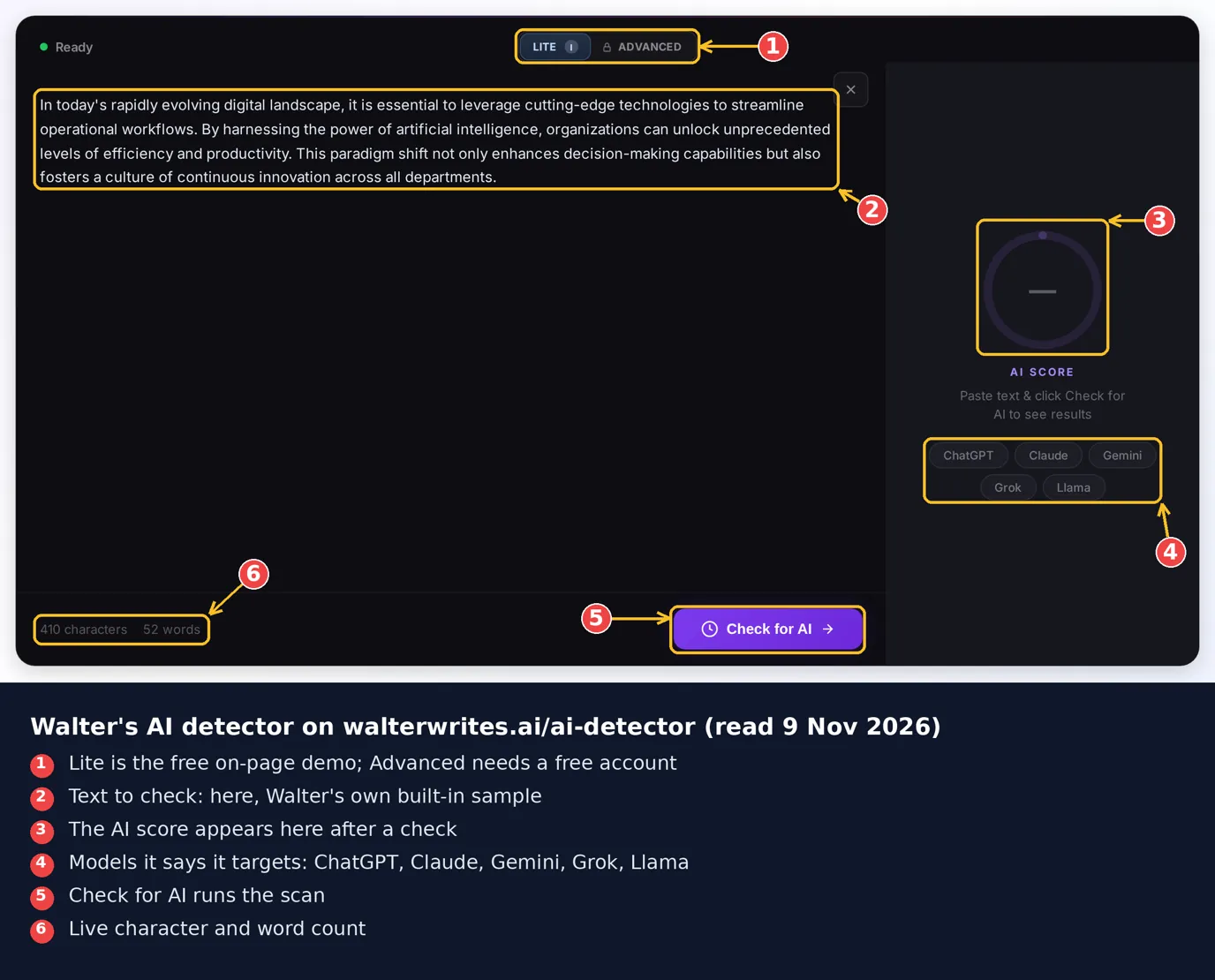
Under 20% on Turnitin's AI score shows as an asterisk; 20% and above is a number your instructor may ask about. Similarity is a separate score with its own bands and no universal limit. Check your draft in Walter's free AI detector first, and read Does Turnitin detect Walter Writes AI? for how Walter's rewrites score.
For the AI score, 20% is the line where Turnitin starts showing a number at all; below it you see only an asterisk. Turnitin says documents over 20% have a false positive rate under 1%, so a 20% AI score is worth a conversation, not a verdict. For the similarity score, 20% sits in Turnitin's green band (1% to 24%) and is often fine if your quotes are cited.
It depends which score. A 25% similarity score enters Turnitin's yellow band (25% to 49%), and whether that is acceptable is set by your instructor, not by Turnitin. A 25% AI score means Turnitin estimates about a quarter of the text reads as AI-written, which most instructors will ask about.
For similarity, it can be, especially with properly quoted and cited sources; check your syllabus. For the AI score, 25% is above the 20% line where Turnitin reports a number, so check your draft before you submit.
It means Turnitin found less than 20% AI writing. Turnitin hides the number and highlights nothing in that range to avoid false positives.
Students cannot run Turnitin themselves. Run your final draft through Walter's free AI detector, which needs no sign-up, and revise any passage it flags in your own words.
Anything under 20% is shown only as an asterisk with no highlights, which is where you want to be.
For the AI score, 30% is above the 20% line, so Turnitin shows the number and highlights text. For similarity, 30% is in the yellow band; check your instructor's limit.
Turnitin found less than 20% AI writing. It hides the number in that range to avoid false positives.
GPTZero matches Turnitin on human writing but not on edited or rewritten AI text. Here is the 2026 evidence and the free checks worth running instead.
Read →Turnitin does not sell to individuals, so there is no official free Turnitin check. Here is how students pre-check a paper for free instead.
Read →Signal, not proof: Turnitin's own error rates, a 2026 study of 160 papers, the universities that switched it off and how to protect your work.
Read →