GUIDES · 9 min
Can I Test Turnitin for Free? What Works
Turnitin does not sell to individuals, so there is no official free Turnitin check. Here is how students pre-check a paper for free instead.
Read →Blog › GUIDES
No in Walter's 2026 tests: its rewrites averaged about 12% on Turnitin's AI score, under the 20% line. How Turnitin works, what it flags and how to check.
No: Walter's 2026 tests put its rewrites at about 12% on Turnitin's AI detection, below the 20% level where Turnitin shows no score. Walter's own 2026 testing puts its humanized output at about 12% on Turnitin's AI detection on average, and Turnitin does not show a score at all below 20%: to avoid false positives, it displays an asterisk (*%) instead of a number and highlights nothing in the document (Turnitin Help Center). Your own result depends on your draft and how much you edit it, so check the final version in Walter's free AI detector before you submit.
| Text | Average Turnitin AI score (Walter's 2026 test) | What Turnitin shows |
|---|---|---|
| Unedited AI text | about 86% | A score and highlights |
| Typical paraphraser | about 62% | A score and highlights |
| Walter rewrite | about 12% | *% (no score, no highlights) |
No humanizer can promise a score on every paper; edit the rewrite in your own voice and check it before you submit.
Turnitin reads a submission and estimates how much of it looks like text from a large language model. In its own words, its effort has gone into a high accuracy rate "accompanied by a less than 1% false positive rate", and it tells instructors that because the false positive rate is not zero they need to apply professional judgment (Turnitin, 2023). In other words, Turnitin itself presents the AI score as evidence for a conversation, not as a verdict.
That caution is not theoretical. Vanderbilt University disabled Turnitin's AI detector in 2023, citing a lack of insight into how it works and noting that a 1% false positive rate, applied to the 75,000 papers it submitted in 2022, could have meant around 750 papers wrongly labelled (Vanderbilt, 2023), and a Stanford-led study found GPT detectors misclassify non-native English writing as AI far more often than native writing (Liang et al., 2023).
Turnitin only scores qualifying prose, meaning sentences in paragraphs; it does not reliably score bullet points, tables, poetry, code or annotated bibliographies, it needs at least 300 words, and it accepts up to 30,000 words (Turnitin Guides, release notes). That matters for anyone checking a rewrite: a 200 word discussion post, a slide deck or a reference list will not get a reliable AI score from Turnitin at all.
Sometimes, and it is trying harder. Turnitin is not standing still. On 27 August 2025 it added AI bypasser detection, aimed at text changed by humanizer tools; it does not say which tools it catches, and the feature covers English submissions only (Turnitin, 2025). Its release notes list further English model updates on 14 October 2025 and 12 February 2026, each described as improving recall while keeping a low false positive rate (Turnitin Guides).
Two details in Turnitin's own wording are worth noticing. First, it targets "leading" bypassers without naming them, so there is no public list of tools it catches. Second, bypasser text is folded into the same blue "AI-generated" highlight as raw model output (Turnitin Guides), so an instructor does not see a separate "humanizer" label. Walter's own figures come from 2026 testing, after the bypasser feature launched, and still put its rewrites at about 12% on average.
| Turnitin AI result | What the instructor sees | Where Walter rewrites land in Walter's test |
|---|---|---|
| 0% | 0% with no highlights | Possible on well-edited text |
| 1% to 19% | An asterisk (*%), no number, no highlights | The average Walter rewrite (about 12%) |
| 20% to 100% | The percentage, with AI text highlighted in blue | Typical paraphrasers (about 62%) and raw AI (about 86%) |
Display rules from the Turnitin Help Center and Turnitin Guides; averages from Walter's AI Humanizer page, labelled as Walter's own test. The AI score also sits apart from the similarity score: a rewrite can have a low AI score and still show matches if you quoted sources, which is normal and expected.
Walter publishes its own figures on its AI Humanizer page: in Walter's 2026 testing, humanized output averaged about 12% on Turnitin's AI detection, against about 62% for typical paraphrasers and 86% for unedited AI text. These are Walter's own test figures; the independent AIHT ranking, below, points the same way.
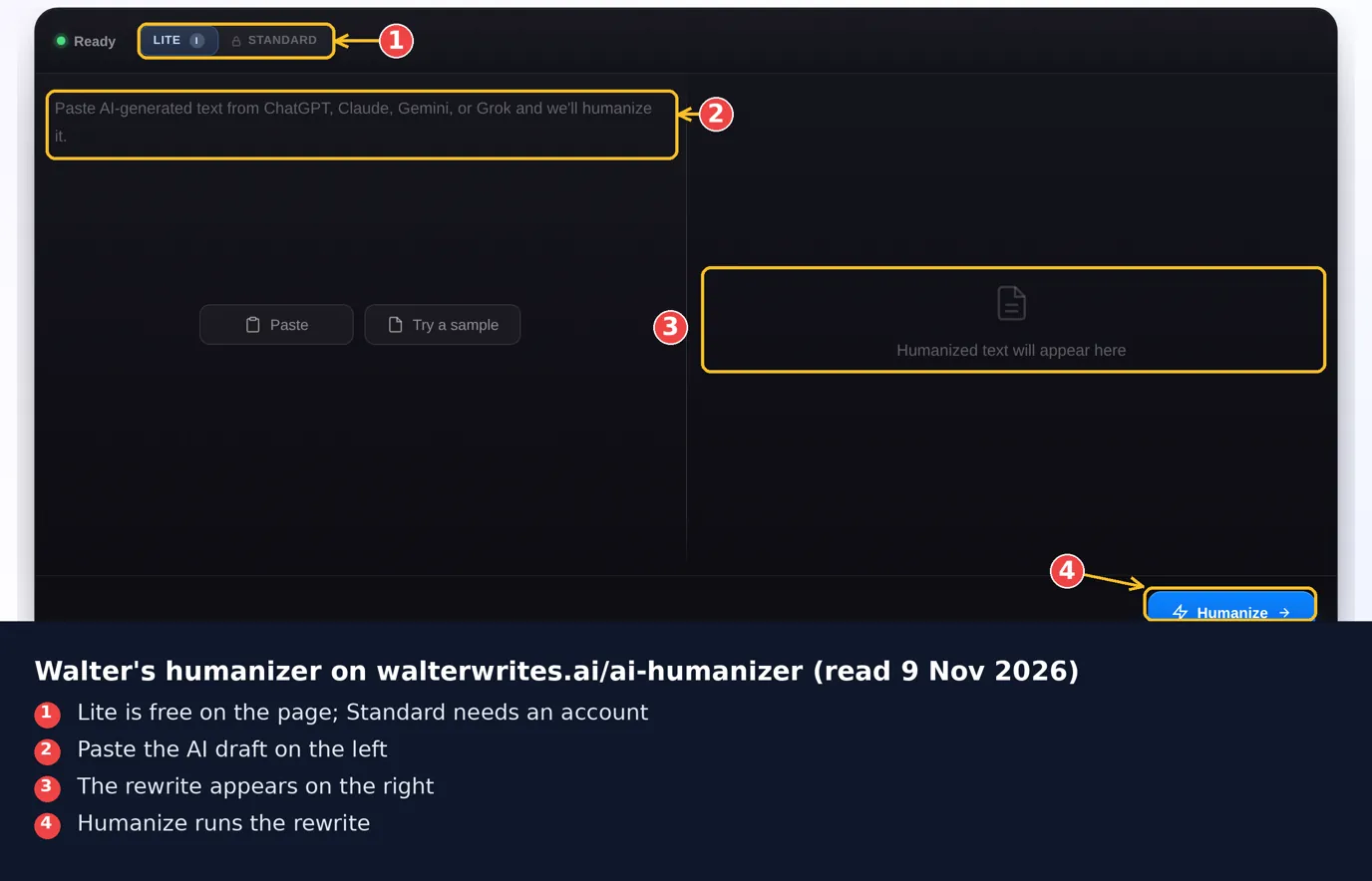
That is a large gap: Walter's rewrites score about a seventh of what raw AI text scores, and well under half of what typical paraphrasers score. Your own result will depend on your draft and how much you edit it, which is why the free detector is built in.
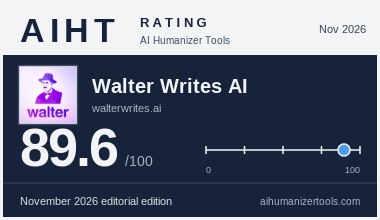
In the November 2026 edition of the AIHT Rating from AI Humanizer Tools, Walter Writes AI scores 89.6 out of 100 and ranks first of 16 humanizers, ahead of Stealth Writer at 84.47. AIHT reports an 88.0 meaning-preservation score for Walter, the highest of the 16 tools, and lists the edition's sample as 30 texts tested on 2 June 2026. AIHT's five detectors do not include Turnitin, so its numbers tell you how Walter's rewrites fare against GPTZero, Copyleaks, Originality.ai, ZeroGPT and Proofademic, not against Turnitin itself.
| Detector | AIHT score for Walter |
|---|---|
| GPTZero | 97.2 |
| Proofademic | 95.9 |
| Copyleaks | 93.4 |
| ZeroGPT | 91.5 |
| Originality.ai | 88.6 |
Per-detector scores from the AIHT November 2026 edition. AIHT does not include Turnitin in its five detectors.
Academic research shows how much detectors vary on rewritten text. A 2026 study of 160 academic papers found GPTZero identified just 1 of 40 humanised AI papers (2.5%) and 0 of 40 hybrid papers, while still scoring every human paper correctly (Van Vlasselaer et al., 2026). Turnitin did better in the same study, which is why Walter's own Turnitin numbers matter more than a GPTZero screenshot.
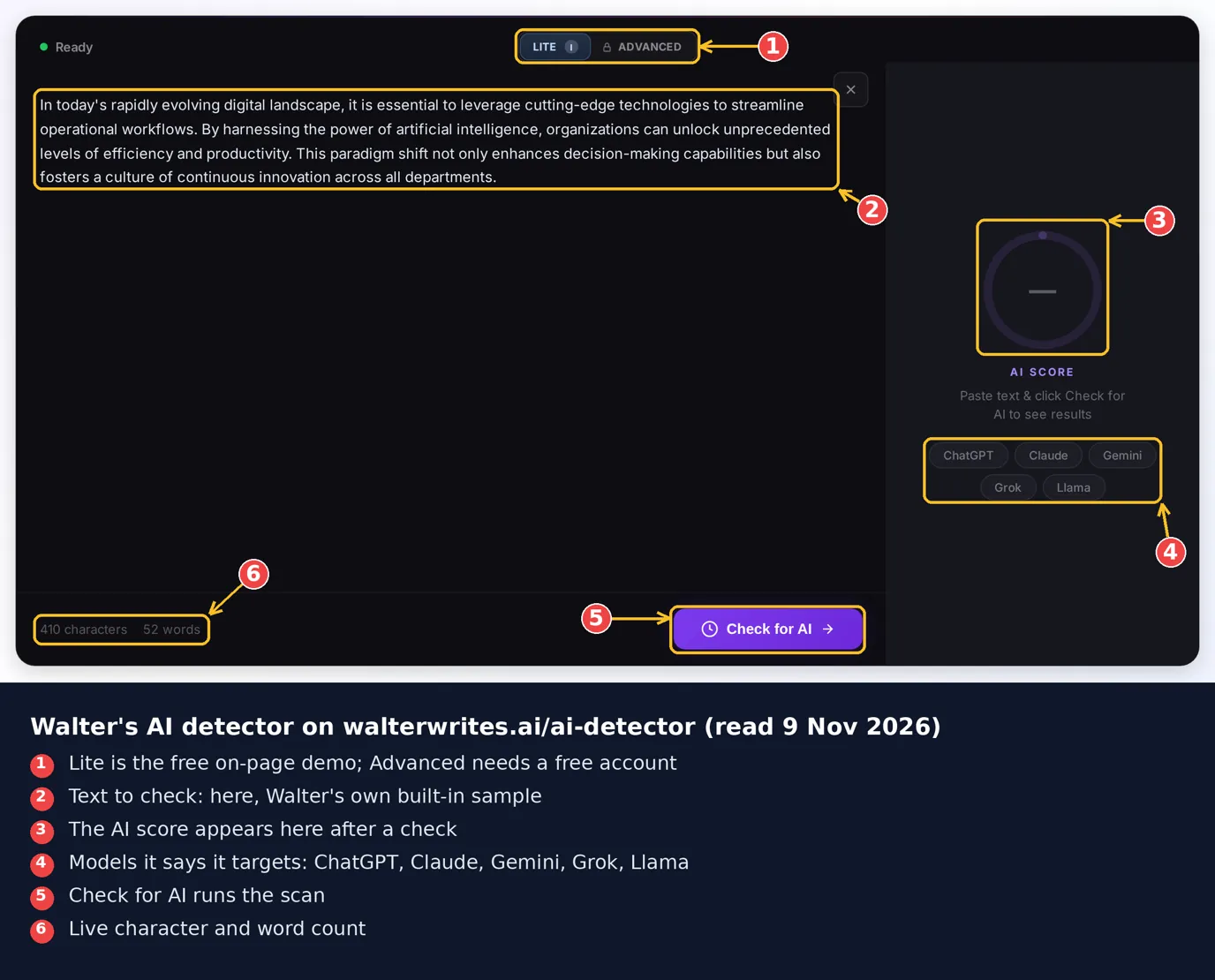
Walter is the strongest humanizer we know of for this job: its own Turnitin numbers are the best published for any humanizer, and it tops the independent AIHT ranking. Edit the result so it sounds like you, follow your course's AI rules, and check the final draft in Walter's free detector before you submit. For how other detectors compare with Turnitin, read Is GPTZero close to Turnitin?, Can I test Turnitin for free?, Is 20% or 25% on Turnitin bad? and Can we trust Turnitin?
Check a draft in Walter's free AI detector before you decide.
No, not in Walter's testing. Its rewrites averaged about 12% on Turnitin's AI detection in Walter's 2026 tests, below the 20% level under which Turnitin shows no score at all. Results on any one paper depend on the draft and how much you edit it, so check the final version in Walter's free detector.
Walter's own 2026 testing shows its rewrites averaging about 12% on Turnitin's AI detection, against about 62% for typical paraphrasers and 86% for unedited AI text. That is the best result we have seen published for any humanizer, and it matches its first-place AIHT Rating.
Turnitin updates its model over time, so any result is a snapshot. Re-test with current text rather than relying on an old screenshot or a Reddit thread.
Turnitin added AI bypasser detection for English submissions on 27 August 2025 and does not say which humanizers it catches. Walter's own 2026 testing, after that launch, still puts its rewrites at about 12% on average, under the 20% line where Turnitin shows only an asterisk.
That depends on your course rules, not on any score. If your institution does not allow AI drafting, rewriting the draft does not change that. If it does allow AI help, keep your notes and version history so you can show your process.
Ask to see the report, bring your drafts, notes and document version history, and remind your instructor that Turnitin itself says its false positive rate is not zero and that the report is for their judgment, not a verdict.
Yes, by Walter's own 2026 testing: its rewrites averaged about 12% on Turnitin's AI detection, below the 20% level where Turnitin shows no score.
Walter's 2026 testing puts its rewrites at about 12% on Turnitin's AI detection on average, against about 86% for unedited AI text.
About 12% on average in Walter's own 2026 tests, which Turnitin displays as an asterisk (*%) with no highlights, since it shows no number below 20%.
Turnitin does not sell to individuals, so there is no official free Turnitin check. Here is how students pre-check a paper for free instead.
Read →A 20% or 25% Turnitin score means different things for the AI score and the similarity score. Here is how to read each one, and how to check your draft first.
Read →Signal, not proof: Turnitin's own error rates, a 2026 study of 160 papers, the universities that switched it off and how to protect your work.
Read →