TUTORIAL · 8 min
Real-Time AI Detection: WebSocket vs REST API Approaches
When to use WebSocket streaming vs synchronous REST for AI detection. Latency tradeoffs, implementation patterns, and when each approach makes sense.
Read →Blog › RESEARCH
GPTZero matches Turnitin on human writing but not on edited or rewritten AI text. Here is the 2026 evidence and the free checks worth running instead.
No: in a 2026 study, Turnitin caught 50% of humanised AI papers while GPTZero caught 2.5%, so GPTZero is not a close stand-in for Turnitin. The two agree on human writing (both scored every human paper correctly) and split on edited AI text (Van Vlasselaer et al., 2026). For a free pre-check, start with Walter's free AI detector.
| Paper type | Turnitin | GPTZero |
|---|---|---|
| Fully human, scored correctly | 100% | 100% |
| Hybrid human and AI, caught | 60.0% | 0.0% |
| Humanised AI, caught | 50.0% | 2.5% |
No detector score, Turnitin's included, should be the only evidence in a misconduct case.
Researchers at a Belgian university wrote 160 academic papers with known authorship (fully human, fully AI, hybrid, and AI text run through a humanising prompt) and scored them with four detectors, including Turnitin, GPTZero and Copyleaks (Van Vlasselaer et al., 2026). Because the ground truth was known, the results show how closely each tool tracks reality, and how closely the tools track each other.
| Paper type | Turnitin | GPTZero | Copyleaks |
|---|---|---|---|
| Fully human (scored correctly) | 100% | 100% | 100% |
| Hybrid human and AI (strict accuracy) | 60.0% | 0.0% | 30.0% |
| Humanised AI (strict accuracy) | 50.0% | 2.5% | 22.5% |
Figures from the study's results section (International Journal for Educational Integrity, 2026). On fully AI papers written with newer models, the study reports Turnitin missed all of them and GPTZero and Copyleaks missed most.
The study's real value is that it split results by how each paper was written. That maps directly onto how students actually use AI:
Turnitin has also added bypasser detection (August 2025) and shipped English model updates in October 2025 and February 2026 (Turnitin release notes), each aimed at catching more AI text, so treat any comparison as a dated snapshot and re-check your own draft.
Both tools scored every fully human paper between 0% and 20%, so neither wrongly flagged human writing in this set. That is the reassuring half of the answer: if you wrote the paper yourself, the two tools are likely to agree that you did.
The gap opens on mixed and rewritten text. Turnitin caught some of it; GPTZero caught almost none. That cuts both ways for a student. A low GPTZero score on a draft that started in ChatGPT is not evidence that Turnitin will also score it low. And a high Turnitin score on your own work is a reason to ask questions, because Turnitin itself says its false positive rate is not zero and that instructors must use judgment (Turnitin, 2023).
Both tools use trained classifiers that estimate how likely each sentence is to come from a language model, then roll those sentence calls into a document score. The differences are in what they were built for and what they will score.
Turnitin grew out of plagiarism checking and sells to institutions. Its AI report scores only qualifying prose, needs at least 300 words and accepts up to 30,000 (Turnitin release notes). It runs separate models for English, Spanish and Japanese, and only the English model includes paraphraser and bypasser detection (Turnitin Guides). Turnitin is not standing still. On 27 August 2025 it added AI bypasser detection, aimed at text changed by humanizer tools; it does not say which tools it catches, and the feature covers English submissions only (Turnitin, 2025). Its release notes list further English model updates on 14 October 2025 and 12 February 2026, each described as improving recall while keeping a low false positive rate (Turnitin Guides).
GPTZero sells directly to teachers, students and other users. By its own description it offers a free tier of 10,000 words a month, a quick scan without an account, a Chrome extension and detection in 10 languages (GPTZero, 2026).
| Turnitin | GPTZero | |
|---|---|---|
| Who can use it | Only through an institution's licence | Anyone; free tier and paid plans |
| Free option for students | None outside your school | 10,000 words a month |
| Length | 300 to 30,000 words of prose | Paste or upload; no account for a quick scan |
| Languages | English, Spanish, Japanese | 10 listed by GPTZero |
| Humanizer (bypasser) detection | Yes, English only, since 27 August 2025 | Not described in its comparison guide |
| Under 20% AI | Shown as *% with no highlights | Shows the score |
Sources: Turnitin Help Center, Turnitin release notes, Turnitin *% guide and GPTZero's own comparison.
Turnitin says documents scored above 20% AI have a false positive rate under 1%, and that about 4% of highlighted sentences may be human-written (Turnitin, 2023). It also tells instructors its model "may not always be accurate" and should not be the sole basis for action (Turnitin Guides). GPTZero's guide says that in late 2023 it reported around 99% accuracy on a defined benchmark set (GPTZero), a vendor figure on its own test set rather than an independent result.
The independent 2026 study above is the fairer comparison, because both tools faced the same papers with known authors. On human writing they tied. On edited AI text Turnitin was clearly stricter.
If you are a student, almost certainly Turnitin, through your learning platform, if your school has its AI indicator switched on. Many do not. A long list of universities have switched Turnitin's AI indicator off: Vanderbilt in 2023 (Vanderbilt), Georgetown, which said "the harms of false positives are worse than any advantages of the tool" (Georgetown UIS), Boston University (BU TechWeb), UC Berkeley after a campus pilot (Berkeley RTL) and Washington State University in February 2026 (WSU Provost). So the first question is not which detector is better, but whether your course runs one at all. Ask your instructor or check the syllabus, and read Can we trust Turnitin? for why so many schools stepped back.
The comparison changes outside English. Turnitin runs separate AI models for Spanish and Japanese, and only its English model includes paraphraser and bypasser detection (Turnitin Guides); in other languages it may not produce an AI report at all. GPTZero lists 10 supported languages (GPTZero). Walter's detector and humanizer cover more than 80 (Walter), which makes it the most practical free pre-check for writers working in, say, Portuguese, French or German. Non-native English writers have a separate concern: published research found detectors misclassify their English writing as AI far more often than native writing (Liang et al., 2023), so keeping drafts matters even more.
Only in one direction. If you wrote the paper yourself and GPTZero says human, Turnitin very likely agrees: in the 2026 study they matched on every human paper. If any part of the paper started as AI output, a low GPTZero score predicts nothing, because that is exactly where the two tools split hardest.
A worked example makes the point. Say a 1,500 word essay has three paragraphs drafted in ChatGPT and lightly reworded. GPTZero might score it low, since it caught none of the hybrid papers in the study. Turnitin, which caught 60% of hybrid papers, has a real chance of showing a number above 20% with those three paragraphs highlighted in blue. The student who trusted the GPTZero screenshot would be surprised; the student who rewrote those paragraphs in their own words would not.
| You are... | What to take from the evidence |
|---|---|
| A student who wrote every word | Both tools are likely to agree you did. Keep drafts anyway, because no detector is perfect. |
| A student who used AI where allowed | Do not rely on GPTZero as a Turnitin preview. Rewrite AI passages in your own voice and pre-check the final draft. |
| A teacher using GPTZero | Expect it to under-flag edited AI text; a low score is not clearance. |
| A teacher using Turnitin | Follow Turnitin's own guidance: the score is not the sole basis for action (Turnitin Guides). |
You cannot run Turnitin yourself; it is sold only to institutions (more in Can I test Turnitin for free?). Our own detector benchmark covers the paid tools. The best free check we know of is Walter's:
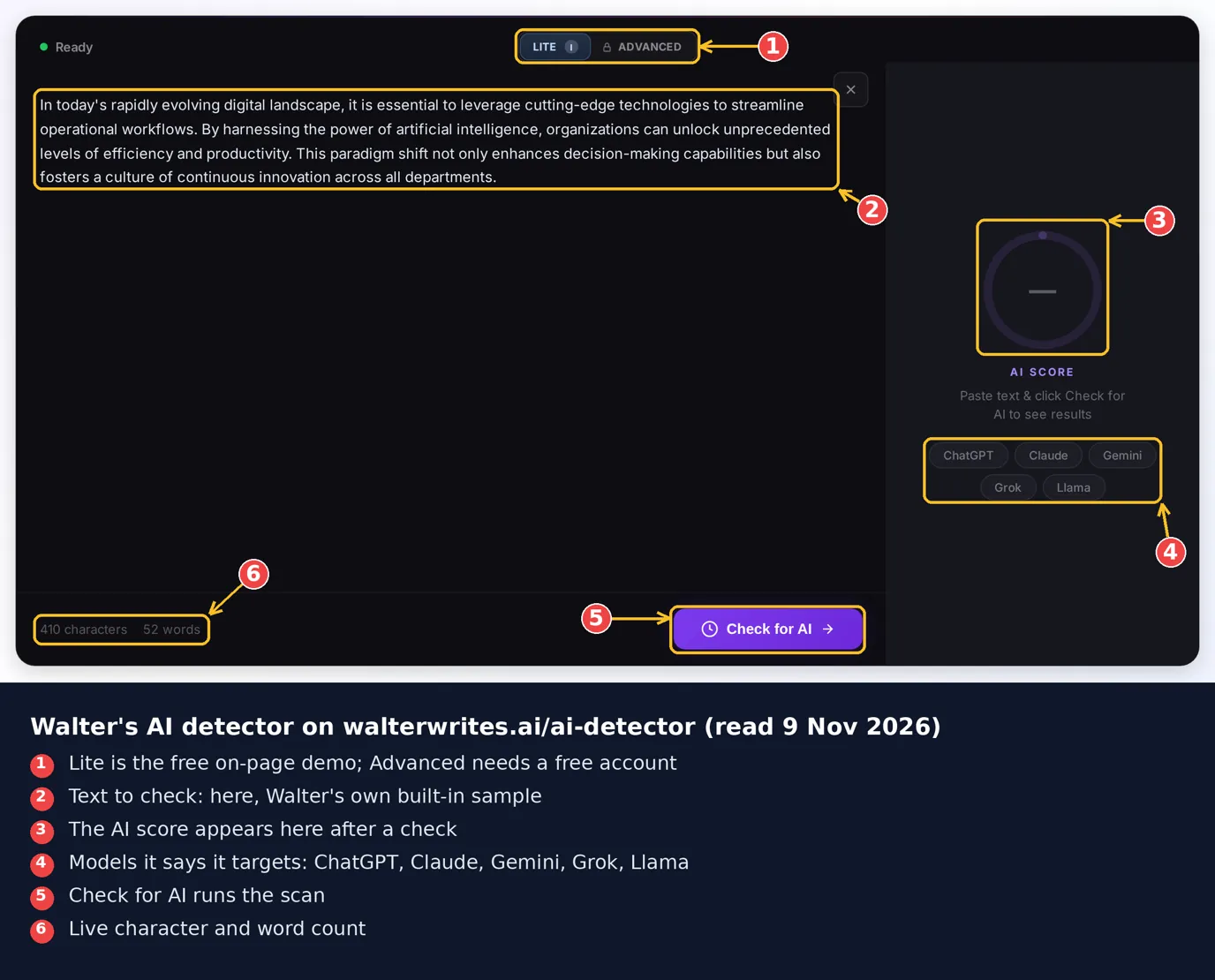
If both say human and you wrote it, you are in good shape. If they disagree, look at the passages that changed least from any AI draft, rewrite them in your own words, and keep your drafts and version history.
A three-step routine gives you the closest free read to Turnitin's strictness:
GPTZero is not a stand-in for Turnitin: they agree on human writing and diverge on everything edited. For a free pre-check, start with Walter's free AI detector, and read our Walter Writes vs GPTZero comparison.
On fully human writing, yes: in a 2026 study both scored every human paper correctly. On edited or rewritten AI text, no: Turnitin caught 60% of hybrid papers and 50% of humanised papers, while GPTZero caught 0% and 2.5%. A clean GPTZero score does not predict a clean Turnitin score.
Not on mixed or rewritten text: in the 2026 study Turnitin caught 60% of hybrid and 50% of humanised papers, GPTZero 0% and 2.5%. Both scored every human paper correctly.
In the same study Copyleaks caught 30% of hybrid papers and 22.5% of humanised papers, against Turnitin's 60% and 50%, so no, not on edited AI text.
No free tool reproduces Turnitin, which is sold only to institutions. The best free check we know of is Walter's AI detector: free, no sign-up, covers ChatGPT, Claude, Gemini, Grok and Llama, and is built to keep false positives low.
They use different models and thresholds. In the 2026 study they agreed on human writing and disagreed most on text that mixed human and AI writing or had been rewritten.
Not on edited text. In a 2026 study they agreed on human writing but Turnitin caught 60% of hybrid papers and GPTZero none.
ZeroGPT was not part of the 2026 study. For a free pre-check before Turnitin, use Walter's free AI detector.
You can, but the 2026 study shows a clean GPTZero result often does not match Turnitin on edited text. Walter's free detector is a stronger first check for your own draft.
When to use WebSocket streaming vs synchronous REST for AI detection. Latency tradeoffs, implementation patterns, and when each approach makes sense.
Read →What enterprise teams need to know before deploying AI detection at scale: data handling, SOC2 compliance, GDPR considerations, and building an audit-ready detection program.
Read →How much content online is AI-generated, where it is concentrated, and what that means for detection at scale.
Read →