RESEARCH · 9 min
Best AI Detector APIs in 2026: Complete Comparison
We tested every major AI detection API on 2,400 text samples. Here is the complete ranking with accuracy rates, latency benchmarks, and use-case recommendations.
Read →Blog › RESEARCH
Signal, not proof: Turnitin's own error rates, a 2026 study of 160 papers, the universities that switched it off and how to protect your work.
Partly: Turnitin says its document false positive rate is under 1% above 20% AI, but a 2026 study found it caught only 50% of humanised AI papers. Trust Turnitin's AI score as a signal, not proof; Turnitin itself tells educators to use it to start a conversation (Turnitin, 2023). Check your own draft first in Walter's free AI detector.
| Measure | Figure | Source |
|---|---|---|
| Document false positives (over 20% AI) | under 1% | Turnitin, 2023 |
| Sentence-level false positives | about 4% | Turnitin, 2023 |
| Minimum length for an AI check | 300 words | Turnitin, 2023 |
| Humanised AI papers caught | 50% | Van Vlasselaer et al., 2026 |
| Human papers scored correctly | 100% | Van Vlasselaer et al., 2026 |
No detector score should be the only evidence in a misconduct case.
All four points come from Turnitin's Chief Product Officer (2023). Turnitin also says it "does not make a determination of misconduct" and that instructors must apply professional judgment because the false positive rate is not zero (Turnitin, 2023).
A 2026 study of 160 academic papers with known authorship found Turnitin scored every fully human paper correctly, which is good news for honest writers. But it missed all fully AI papers written with newer models, and caught 60% of hybrid papers and 50% of humanised ones (Van Vlasselaer et al., 2026). Detection is a moving target.
Earlier research also found GPT detectors misclassify non-native English writing as AI far more often than native writing (Liang et al., 2023), and Vanderbilt University disabled Turnitin's AI detector in 2023, citing a lack of insight into how it works and noting that a 1% false positive rate on its 75,000 papers a year could mean about 750 wrongly labelled (Vanderbilt, 2023).
Turnitin's own guide for instructors says its AI writing model "may not always be accurate" and should not be the sole basis for action against a student, and that the AI percentage is separate from the similarity score (Turnitin Guides). The same guide says it "takes further scrutiny and human judgment" together with a school's own policies to decide whether misconduct happened. Read plainly, Turnitin's own documentation describes a screening tool, not evidence that stands on its own.
Most worry about Turnitin centres on false positives, honest work flagged as AI. The 2026 study shows the opposite error is larger: Turnitin missed every fully AI paper written with newer models and caught only half of the humanised ones (Van Vlasselaer et al., 2026). Turnitin is clearly working on this. Turnitin is not standing still. On 27 August 2025 it added AI bypasser detection, aimed at text changed by humanizer tools; it does not say which tools it catches, and the feature covers English submissions only (Turnitin, 2025). Its release notes list further English model updates on 14 October 2025 and 12 February 2026, each described as improving recall while keeping a low false positive rate (Turnitin Guides). But every model update is a new snapshot, and a detector that misses a large share of AI text cannot be read as proof either way. How this plays out for one humanizer is in Does Turnitin detect Walter Writes AI?
A long list of universities have switched Turnitin's AI indicator off: Vanderbilt in 2023 (Vanderbilt), Georgetown, which said "the harms of false positives are worse than any advantages of the tool" (Georgetown UIS), Boston University (BU TechWeb), UC Berkeley after a campus pilot (Berkeley RTL) and Washington State University in February 2026 (WSU Provost).
| Institution | When | Stated reason, in brief |
|---|---|---|
| Vanderbilt University | August 2023 | No insight into how it works; about 750 papers a year could be wrongly labelled at a 1% error rate |
| Boston University | July 2023 | False positives and lack of supporting evidence |
| Georgetown University | October 2023 | Harms of false positives outweigh the benefits |
| UC Berkeley | After a campus pilot | Pilot results plus outside research |
| Washington State University | February 2026 | Any false positive can lead to an integrity case against a student |
Each row links to the institution's own page in the sources below. Many other schools keep the indicator on, but most of them also tell staff not to act on the score alone.
A widely cited 2023 study tested seven detectors on real TOEFL essays and found more than half of the non-native samples were misclassified as AI, while native samples were almost always judged correctly (Liang et al., 2023). UC Berkeley cites that study, and a 2025 follow-up showing the pattern still holds, in explaining why it opted out of Turnitin's AI indicator (Berkeley RTL). If English is your second language, keep your drafts and say so if a score is ever raised.
On edited AI text, yes. In the same 2026 study it caught 60% of hybrid papers against 30% for Copyleaks and 0% for GPTZero, and it tied them on human writing (Van Vlasselaer et al., 2026). So Turnitin is the strictest of the common detectors, which is exactly why it is worth checking your own draft before it gets there. See Is GPTZero close to Turnitin? for the full comparison.
Turnitin is careful about flagging human writing and honest about its limits. It is not a lie detector, and its own maker does not want it used as one. For a student, the practical takeaway is simple: do not let Turnitin be the first detector to see your work.
If the highlights sit mostly on your opening and closing sentences, remember that Turnitin itself says false positives cluster there (Turnitin, 2023).
Stay factual and bring evidence. A short, calm script works better than a long defence: "I wrote this myself. Here are my notes, my earlier drafts and the document's version history. Turnitin's own guidance says the AI score should not be the sole basis for action, so I would like us to look at my process together." Then show the drafts. A visible writing history answers the question a percentage cannot. If you want to check before you submit, here is what free pre-checks can and cannot tell you.
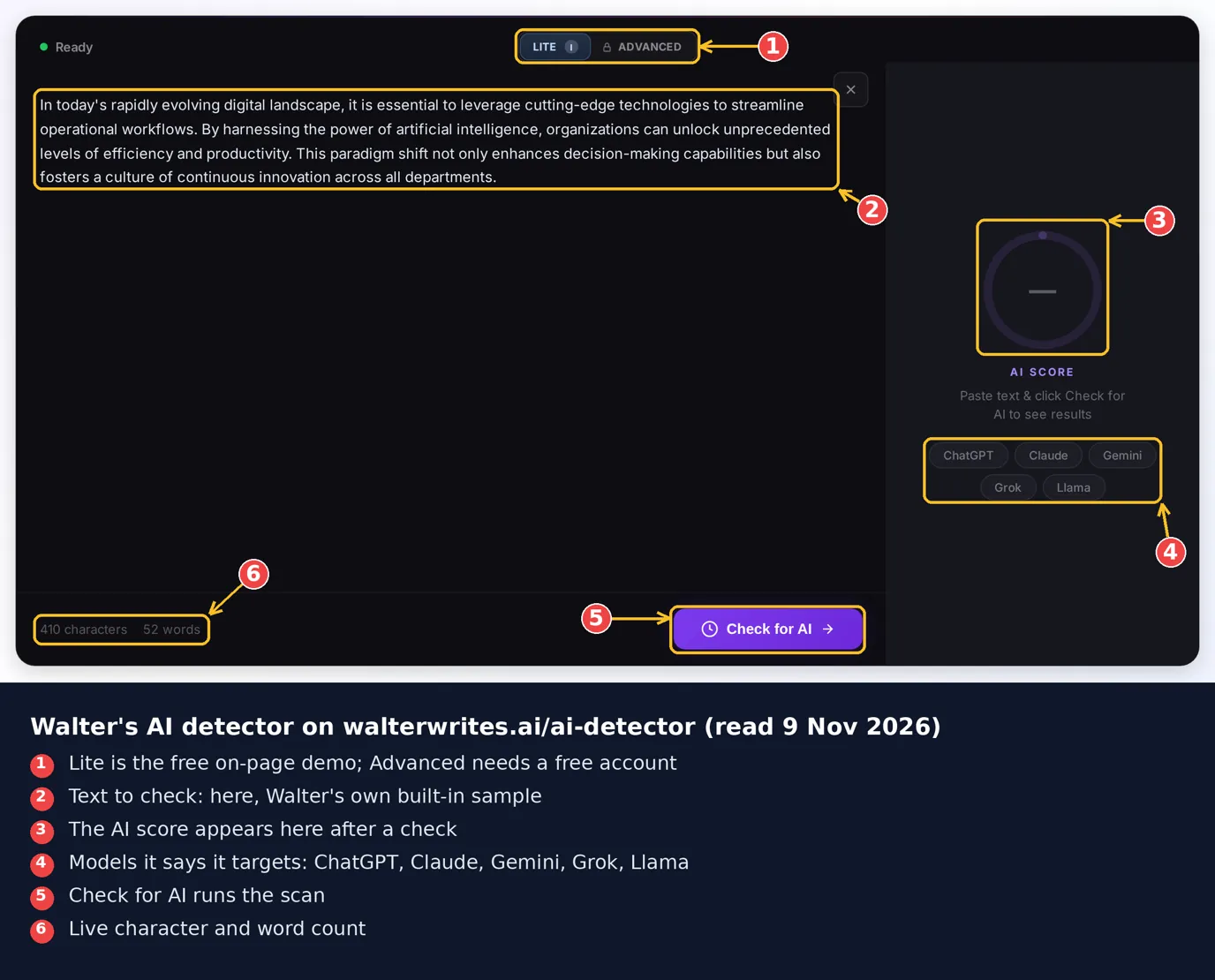
Turnitin is a useful signal with known error rates, not a verdict. Check your work with Walter's free AI detector before you submit, and see what a 20% or 25% Turnitin score means.
As a signal, yes; as proof, no. Turnitin says its document false positive rate is under 1% above 20% AI and its sentence-level rate is about 4%, and it tells educators to use the score to start a conversation. A 2026 study found it caught 60% of hybrid and 50% of humanised AI papers, and Vanderbilt University disabled it in 2023.
Turnitin reports a document false positive rate under 1% for documents above 20% AI. Independent testing in 2026 found it scored every human paper correctly but missed all fully AI papers written with newer models, and caught 60% of hybrid and 50% of humanised papers.
Yes. Turnitin itself says its false positive rate is not zero, that sentence-level false positives run about 4%, and that false positives are more common in the first and last sentences of a document.
Vanderbilt said it had no insight into how the detector works and noted that a 1% false positive rate on the 75,000 papers it submitted in 2022 could have meant around 750 papers wrongly labelled.
Write in your own voice, check your final draft in a free detector such as Walter's before you submit, and keep your drafts, notes and version history.
It is careful with human writing: a 2026 study found it scored every human paper correctly. It is less reliable on edited AI text, catching 50% of humanised papers.
Yes. Turnitin says about 4% of highlighted sentences may be human-written and that documents with over 20% AI have a false positive rate under 1%.
Ask for the report, bring drafts and version history, and point to Turnitin's own statement that its score starts a conversation rather than proving misconduct.
We tested every major AI detection API on 2,400 text samples. Here is the complete ranking with accuracy rates, latency benchmarks, and use-case recommendations.
Read →Perplexity, burstiness, vocabulary entropy, and model fingerprinting: the four statistical signals that separate AI-generated text from human writing.
Read →Not all AI-generated text looks the same. We compared detection accuracy across GPT-4o, Claude 3.5 Sonnet, and Gemini 1.5 Pro outputs using 6 major detectors.
Read →