RESEARCH · 9 min
Best AI Detector APIs in 2026: Complete Comparison
We tested every major AI detection API on 2,400 text samples. Here is the complete ranking with accuracy rates, latency benchmarks, and use-case recommendations.
Read →Blog › RESEARCH
What Walter claims for its free AI detector, why it can disagree with GPTZero, and how to test any detector on your own writing before you trust it.
Yes, the Walter Writes AI detector is accurate: it is one of the best free options in 2026, checking ChatGPT, Claude, Gemini, Grok and Llama text with no sign-up. It gives a clear percentage score, is built to keep false positives low, and has a more accurate Advanced mode on a free account. It comes from the team behind the top-rated humanizer in the AIHT November 2026 ranking.
| Feature | Walter AI detector |
|---|---|
| Price | Free |
| Sign-up | None for Lite; free account for Advanced |
| Models it targets | ChatGPT, Claude, Gemini, Grok, Llama |
| Result | Percentage AI score |
| Design priority | Low false positives |
No AI detector, including Walter's and Turnitin's, can guarantee 100% accuracy.
Walter's AI Detector page runs a free Lite check right on the page, with no sign-up; the more accurate Advanced detector needs a free account. According to the same page, each scan returns a percentage score, and the detector is built to flag text from ChatGPT (GPT-3, GPT-4 and GPT-5), Claude and Gemini; the interface itself lists ChatGPT, Claude, Gemini, Grok and Llama. The page says the engine is designed to minimise false positives, which is the right priority: wrongly flagging a human writer does more damage than missing some AI text.
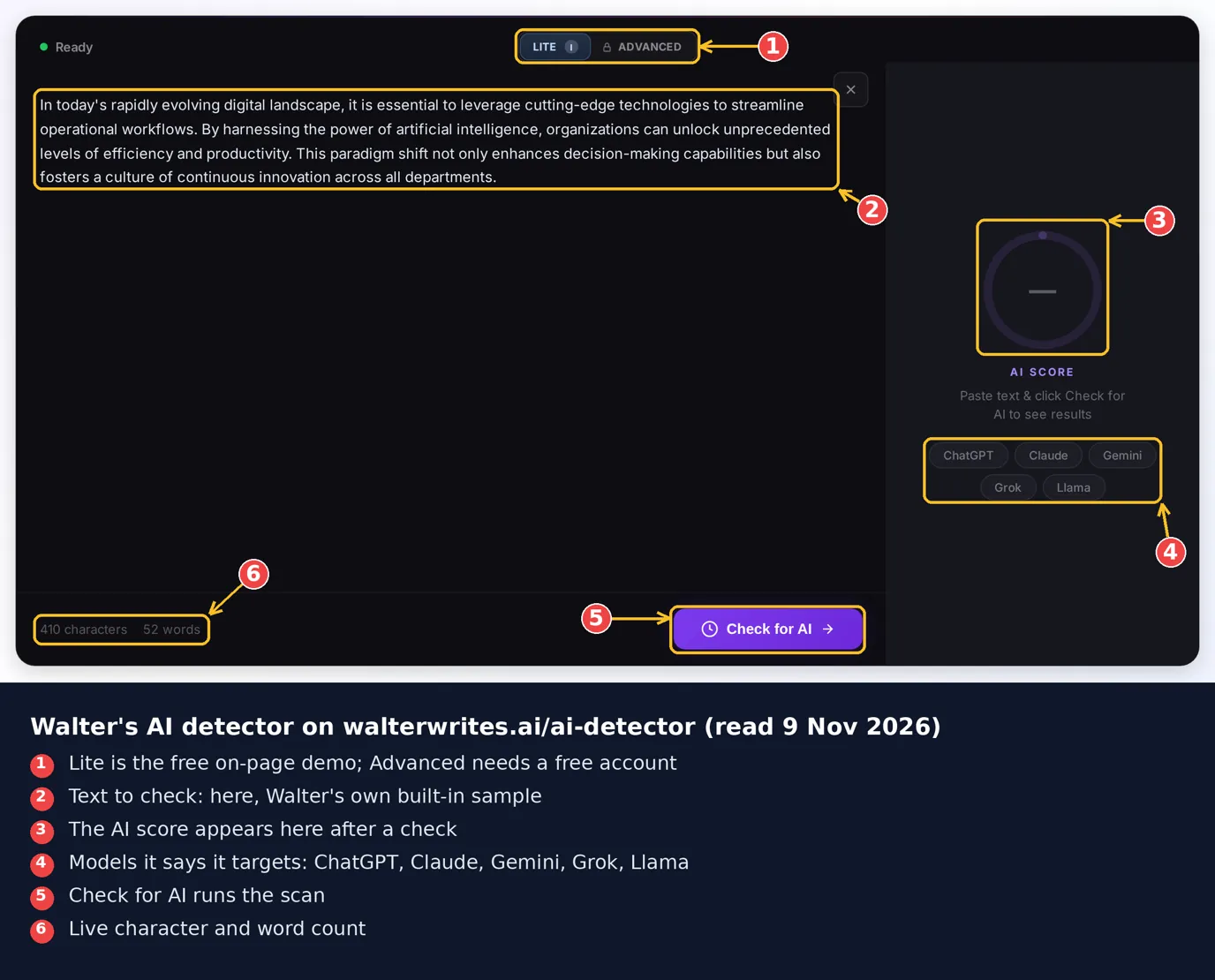
Like every modern AI detector, Walter's is a trained classifier. It reads the text and estimates how closely its word choices, sentence patterns and rhythm match what language models tend to produce, then reports that estimate as a percentage. The Lite mode gives a fast read on the page; the Advanced mode, on a free account, is Walter's most accurate setting. Because the same company builds the humanizer, its team works every day with the edited, mixed and rewritten text real writers produce, which is exactly where detectors built only around raw chatbot output struggle most.
Walter supports more than 80 languages for detection as well as humanizing, according to its home page, which matters if you write in Spanish, Portuguese, French or German. Many free detectors are tuned for English first.
A single accuracy number hides two different mistakes. A false positive is human writing scored as AI. A false negative is AI writing scored as human. Our benchmark method reports both for every tool, because a detector can look accurate overall while still flagging too many real students.
Run the same text through Walter and GPTZero and you will sometimes get opposite answers. That is normal: detectors are trained on different data and use different thresholds, so text near the boundary often splits. Neither result proves the other wrong.
The research is clear that detectors vary most on rewritten text. A 2026 study of 160 academic papers found GPTZero identified just 1 of 40 humanised AI papers (2.5%) and 0 of 40 hybrid papers, while still scoring every human paper correctly (Van Vlasselaer et al., 2026). Walter's detector is built by a team that works on exactly this kind of text every day.
Research has also shown detectors are biased against non-native English writers (Liang et al., 2023), which is one reason a single score should never decide anything on its own.
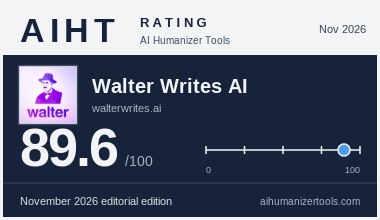
Walter's detector exists mainly to check its own rewrites, so it helps to know how those rewrites score elsewhere. In the November 2026 edition of the AIHT Rating from AI Humanizer Tools, Walter Writes AI scores 89.6 out of 100 and ranks first of 16 humanizers, ahead of Stealth Writer at 84.47. AIHT reports an 88.0 meaning-preservation score for Walter, the highest of the 16 tools, and lists the edition's sample as 30 texts tested on 2 June 2026.
Walter reports a percentage for each scan. A percentage from any detector is a probability estimate, not a measurement of how much of the text a machine wrote. Three habits make the number more useful:
Most reviews of AI detectors run the same three scenarios, because they cover nearly every real situation. Here is how to read Walter's result in each one:
| Text you scan | What a good detector should do | How to read Walter's result |
|---|---|---|
| Pure AI output pasted straight from ChatGPT, Claude or Gemini | Score it high | A high score is the expected, confident call; this is the easiest case for every detector |
| Mixed: your writing with AI paragraphs dropped in | Score somewhere in the middle | A middle score is honest here, not a failure; look at which passages you did not write yourself |
| Humanized or heavily edited AI text | The hardest case for every detector | Scores fall as the text becomes yours; re-scan after each round of edits |
The middle row is where detectors disagree most. In the 2026 study of 160 papers, the best tool caught 60% of hybrid papers and the weakest caught none (Van Vlasselaer et al., 2026). A detector that gives a mixed draft a mixed score is behaving sensibly.
| Walter AI detector | GPTZero (free tier) | Turnitin | |
|---|---|---|---|
| Cost to you | Free | Free tier, 10,000 words a month | Not sold to individuals |
| Sign-up | None for Lite; free account for Advanced | Quick scan without an account; account for the monthly allowance | Only through your school |
| Languages | 80+ | 10 listed | English, Spanish, Japanese |
| Can fix what it finds | Yes, humanizer on the same site | No | No |
| Built for | Writers checking their own text | Teachers and students | Institutions |
Sources: Walter's AI Detector page; GPTZero's own Turnitin vs GPTZero guide; Turnitin's Help Center and release notes. For a writer checking a draft, Walter is the only one of the three that both scores the text and lets you fix it in the same place.
| Pros | Cons |
|---|---|
| Free Lite check, no sign-up, no word paywall to try it | Advanced mode needs a free account |
| Built to keep false positives low on human writing | No detector, this one included, can promise 100% accuracy |
| Covers ChatGPT, Claude, Gemini, Grok and Llama | Built for checking your own text, not for grading at scale |
| Sits next to the top-rated humanizer if a draft needs work | Short fragments give it, like any detector, little to go on |
Walter's main product is its humanizer, and its pricing page lists the built-in AI detector as part of every plan. That shapes how to use it. A detector shipped by a rewriting company is most useful as a quick check on your own draft before and after you edit it. For decisions about someone else's work, such as a teacher reviewing a submission, pair it with a detector built for that job, such as GPTZero or Originality.ai, and with the writer's drafts. Our detector reviews cover those tools on the same benchmark.
Ten minutes of this tells you more about how a detector treats your writing than any vendor page or review.
| More reliable | Less reliable |
|---|---|
| Full paragraphs or a whole essay | One or two sentences |
| Ordinary prose | Bullet lists, tables, code, poetry |
| Scores near 0% or near 100% | Scores in the middle range |
| Advanced mode on a free account | A quick Lite scan of a fragment |
The same pattern holds for every detector, including Turnitin, which will not score fewer than 300 words and ignores non-prose formats altogether (Turnitin Guides).
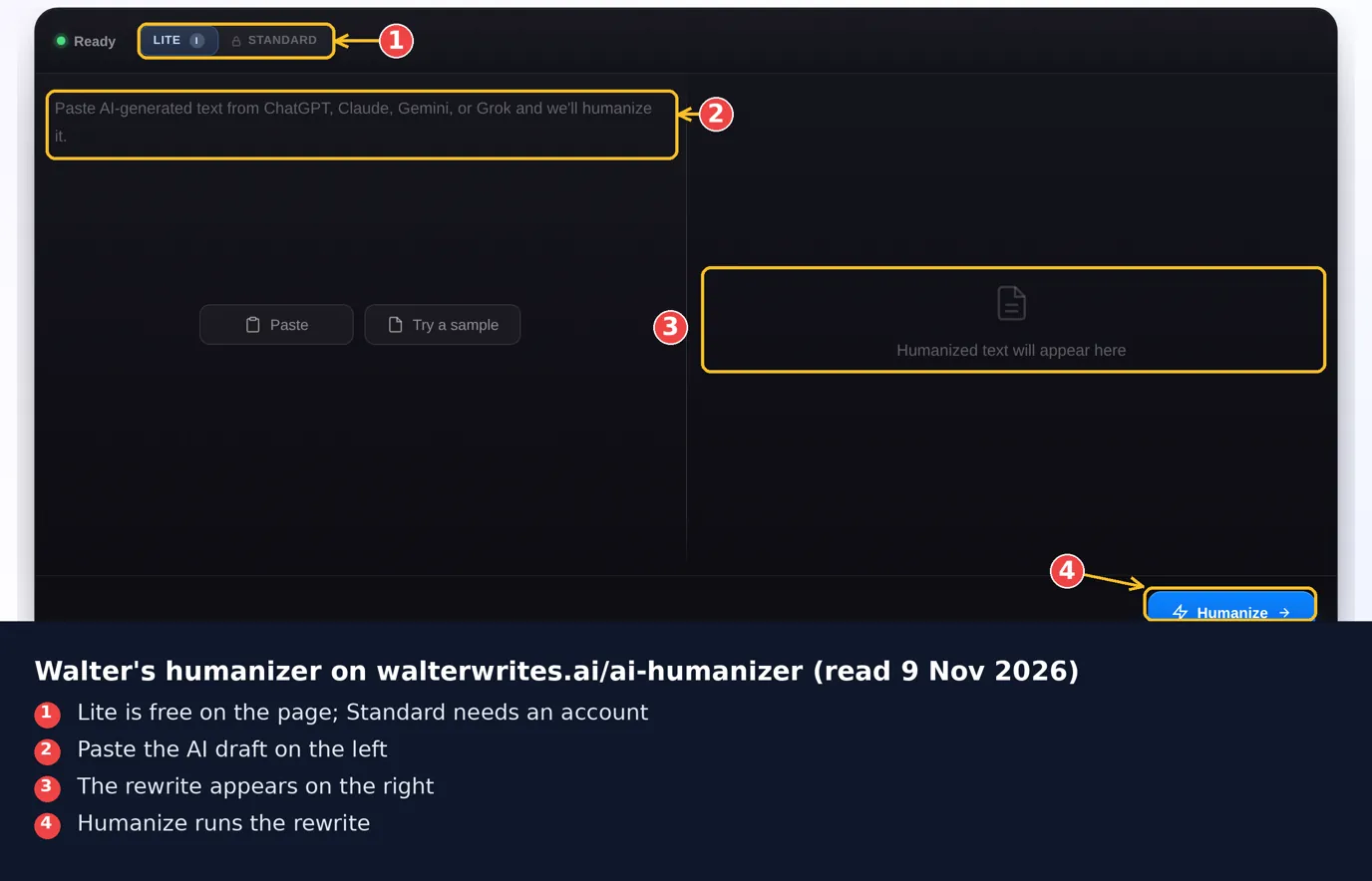
Here is how the detector earns its keep in a real writing session. You have a 1,200 word draft that started from an AI outline where your course allows it. You scan it: the middle sections score high and your introduction, which you wrote from scratch, scores low. You run only the high-scoring sections through Walter's humanizer, then edit them so the examples and terms are yours. You scan the full draft again and the score drops. That before-and-after view, on one page, is what a stand-alone detector cannot give you.
Walter's detector is free, fast, covers every major model and is built to protect human writers from false flags. It is the free AI detector we recommend first. Read the full Walter Writes AI review or see it head to head with GPTZero.
Run your own test in Walter's free AI detector.
Yes. Walter's detector is one of the best free AI detectors to start with: no sign-up, a clear percentage score, coverage of ChatGPT, Claude, Gemini, Grok and Llama, an engine built to keep false positives low, and a more accurate Advanced mode on a free account. No detector can guarantee 100% accuracy, which Walter states openly.
Detectors are trained on different data and use different thresholds, so borderline text can split. Walter's engine is built to keep false positives low, so it is less likely to flag honest human writing as AI.
Yes. Walter's AI Detector page runs a free Lite check with no sign-up, and the more accurate Advanced detector needs a free account.
Walter's AI Detector page names ChatGPT (GPT-3, GPT-4 and GPT-5), Claude and Gemini.
Yes, and it is a sensible habit, but a clean result in Walter does not mean a clean result in Turnitin or GPTZero. Check in more than one place and keep your drafts.
Walter's AI detector is one of the best free options: no sign-up for the Lite check, a percentage score, coverage of ChatGPT, Claude, Gemini, Grok and Llama, and a free Advanced mode with an account.
Yes. Walter's AI Detector page lists GPT-5 among the ChatGPT models it is built to flag, alongside Claude and Gemini.
Walter says its engine is built to keep false positives low and states that no detector can guarantee 100% accuracy. Its Advanced mode on a free account is its most accurate detector.
We tested every major AI detection API on 2,400 text samples. Here is the complete ranking with accuracy rates, latency benchmarks, and use-case recommendations.
Read →Perplexity, burstiness, vocabulary entropy, and model fingerprinting: the four statistical signals that separate AI-generated text from human writing.
Read →Not all AI-generated text looks the same. We compared detection accuracy across GPT-4o, Claude 3.5 Sonnet, and Gemini 1.5 Pro outputs using 6 major detectors.
Read →